Somewhere in a lesser known part of the world, there was this village: bonny, serene and bounteous. Surrounded by mountains and thick forests, this beautiful place looked as if the heaven itself manifested on the earth. From the tall mountains distantly, yet distinctly visible, fresh, clear, and pure water, flowing as a stream across the village, was the invigorating element, and the only source of water for the village.
The blacksmiths, the carpenters, the sculptors and the potters were the only four artisan-communities that lived in the village. They were isolated from one another and settled down one community in each corner of the village. Each community produced its own food, built its own houses, weaved its own clothes, used its own crafts for daily chores, had its own laws and lived as a self-sustaining system, bounded by its territory. They never bothered about other communities. They were accustomed to the way they had been living, since generations. They neither knew nor cared to know why they lived like that.
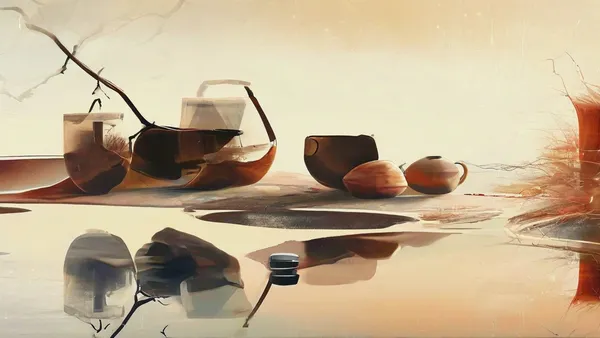
The people of a community wouldn’t usually run into the people of other communities anywhere, except at one place—the stream bank. They come to the bank to fetch water in their utensils and carry it back home. The blacksmiths brought metal pitchers, the carpenters brought wooden tumblers, the potters used earthen pots and the sculptors brought stone jars. They came in groups, fetched water and walked back home, strictly minding their own work. Simple routine. No monkey business.
One morning, four children, one from each of the four communities, were playing at the stream bank, individually. Innately immature to comprehend why their elders warned them not to talk to the children of other communities, each kid felt curious about the others and wanted to talk to them. So, they came close, started talking and introduced themselves. What started as four children talking with childlike glee, gradually became more and more childish: all of them began to brag about their communities. Not surprisingly, a few moments later, each kid started to proudly argue that his community was the greatest. Momentarily, the naive argument turned out to be a heated debate. They began yelling at each other. One thing led to another and in no time, they started to scuffle each other with their hands, tussle with their legs and eventually fell to the ground as they fought.
Sometime later, a few elders who were approaching the bank with utensils to fetch water watched the fight from a distance and rushed to the fighting children instantly. They picked the kids up from the ground, pulled them apart and scolded them for fighting. After inquiring why they fought, surprisingly, even the elders took sides of the argument. Soon joined by the other villagers, now elders from all the communities were assembled at the bank. The elders then continued the argument of the children. Hours of altercation about the question ‘which community was the greatest?’ witnessed the villagers exchange vehement abuses. But it took forever to concur on an answer. The argument tested their patience.
In a spurt of rage, one man threw his utensil at a fellow from another community. No sooner had he thrown his utensil than the entire mob began throwing their utensils at one another. Soon, many men were injured by the utensils thrown by the others. Children were frightened. Women were holding to their children, laying their arms around their children to shield them. With all the men busy fighting, the women were who were shielding their children were left vulnerable to the mob. Casualties resulted. Many parents succumbed to their wounds and many children were killed in the stampede that ensued. The fight continued all the day. More men, women, and children died. This was the first conflict in the history of the village, and it eventually turned out to be the last one. By nightfall, the village had no one else to fight or cry. None from any community survived. All the villagers were dead. The entire village became a necropolis in just one day.
Weeks later, the village had rotting corpses all over the place. The dented metal pitchers rusted out. The dismantled wooden tumblers were decaying. The bloodstained stone jars were implanted in the soil. The broken earthen pots coalesced into the soil. Everything that the villagers had built fell to the ground. Nothing remained. The melancholy of the land was greeted by the bright sun, the fresh breeze, the clear sky, and the splashing water of the stream. The bloody water was washed away downstream and was replaced by the water coming from the mountain end: fresh, pure and clear again, flowing munificently, as invigorating as ever. Pertinent to the stream, nothing changed.
End of story.
A few months ago, I sat for a group discussion with my friends as a part of my on-campus recruitment training. The topic which our mentor gave us was: ‘Is India really a secular country?’ I had been waiting for a long time to express my views on secularism and it was a near perfect opportunity. That discussion I was a part of, made me think a lot about religion. In fact, the story I just narrated is an elaborated and animated version of the conclusion I provided for the discussion on that day. Per se, my conclusion for that day’s discussion is the moral of this story.
Alright. No further ado. For approaching the moral of this story, I will ask you to relate some characters and elements of this story to some polemical yet important things in our real life. Firstly, relate the blacksmiths, the carpenters, the potters and the sculptors to people in the real world—people subscribing to the various religious faiths. Next, relate the utensils they used to fetch water, to the multitude of religions the world has seen. (I don’t want to take names of any religion here, but I hope you can understand that I mentioned only four utensils for the sake of the story).
Now, why did the villagers come to the stream bank every day? To fetch water. To quench their thirst. To vivify their lives. Now comes the concept of God—my concept of God. I ask you to relate the fresh, pure, and clear water flowing across the village, to God. People quench their thirst—’spiritual’ thirst—with the essence of God, which, in the story, is the water of the stream. Just like water takes the shape of the container it is poured in, the essence of God takes the shape of a container called religion. The essence of God is consummated by the people in the form of religion.
Religion is to God as a container is to water.
Metal pitchers, wooden tumblers, earthen pots and stone jars: they were all just containers. People literally wasted their lives on debating which community that made a particular container, was the greatest of all. Implicitly, they debated which ‘container of water’ was the mightiest of all. Their materials were different; textures were different; shapes were different; yet all the time, the containers carried one and the same thing—the water. And at the end of the day, all the containers fell to the ground. Only the water survived.
People made their utensils. People were served by their utensils. People perished. So did their utensils. But, pertinent to the stream, nothing changed. It flowed munificently, as invigorating as ever. So is God. God never created a religion. If anything, he just created humans; humans created religions as a way to understand the concept of God. I say, why contain God in a ‘container’ called religion, at all? God is not static to be contained. He’s dynamic, like the water. I made my peace with this concept of God long ago, and I’ll be more than happy if I can convince someone to subscribe to my concept of God—God in the God-Water analogy. When I say ‘subscribe to my concept of God’, please understand that I don’t mean to start my own religion. It’s just my way of attempting to understand God.
Well, if you are an atheist and are beginning to hate my ‘preaching’ about the concept of God, there is something in this story for you to take away too. Forget the long moral of the story I tried to scrupulously elaborate for the sake of the God-believers, and please pay attention. Mother Earth has given you, and your God-believing fellow humans, a place in it, for a reason: to live and let live. Please don’t argue that God doesn’t exist and waste your time on it; believers believe anyway. Believers, please stop preaching that your God is omnipresent, omniscient, omnipotent, and other typical stuff; atheists despise that anyway. Religion is one petty thing to worry about in this world which is becoming unsustainable to live at an exponential rate. It is worth neither killing for nor dying for. As I said, God is like water—drink it or don’t, but please keep calm. No fuss. Absolutely.
On the day of the group discussion, when my mentor asked for my words of conclusion, I replied:
“Spirituality is a person’s noble thirst. God is the water which quenches that thirst. Whether we drink the water from a pot, a pitcher, a jug or a glass; it doesn’t matter. Water just takes the shape of the container. God takes the shape of the religion. I believe in ascribing importance to God rather than religion. Give importance to water: only that quenches your thirst; not the jug or the glass.”
On an ending note, I would say, Secularism shouldn’t mean that a ‘State has no religion’ or that ‘all the religions are equal to a State’. In my view, the word religion should be eliminated from the definition of secularism. Secularism should really mean: God is one, or none.